c
I bought my looper maybe 15 years ago. It is a Boss LoopStation RC-20XL Phrase Recorder. Here's what it looks like:

I 1st used it actively in Steve & Chris, 2017-2019. with me & most excellent harpist Steve Konopka (Fuzzy). I don't think you can buy them anymore.
I also used a Digitech LiveStation 3 harmony box. I haven't used that in years. It works great with Eagles, not at all w Louis Armstrong.
What Boss is offering now has buttons rather than pedals. I far prefer pedals, much easier to hit when you are playing standing up, in an unfamiliar configuration.
To start recording a loop, or to start playing it back, you press the left pedal. To stop the loop(s), you hit the right pedal. To erase the loop(s), you press & hold the right pedal.
Playing with a looper, over the years I learned 3 main principles. I added a less important 4th.
- Per excellent looper user Jairaj Schwann: always start the looper on the 1.
Jairaj was a serious musician, degree from UMass Amherst, ab fab bass player. I had mostly found people using loopers to get pretty stale quickly. At a “guitarists” show, Jairaj was playing a 6 string bass. He would lay down a bass track on the looper on the bottom strings. Then add a rhythm track on the middle strings. Then play lead on the top strings. Incredible! & when he got tired of it, he'd wipe the whole thing & start over.
Jairaj told me, “Always start the looper on the 1". I thought I knew better, I tried starting the looper on the 4 a few times. It never worked out. Always start the looper on the 1.
- Given that the looper & the looper playback start on the 1, realize that sometimes you start a solo before you kick the looper in with the rhythm track. You may play 2-5 notes of the solo before you kick the background loop on. See example below.
- This is a more minor point. Realize that, based on what you want to play a solo over, sometimes you will skip a verse or 2 before you kick the looper on to start recording. See example below.
- When I 1st started the looper, I tried to use it as I would pedals on an electric guitar: I would start the looper replay, & then use the (awkward) volume knobs on my guitar to turn the volume of the solo up.
At some point I realized, no! The looper has a knob (upper left of pic) that contols the output level of the recorded loop. I back it down from 12pm to 11pm. So the replayed loop is softer, the solo is at the original louder level. No playing with a volume knob, or overdrive pedal!
I mentioned this to the sound man at an Open Mic I have been playing in Naples. I suggested him hitting the “Solo” button on the guitar channel, to put the rhythm guitar back to the volume it had been at & make the solo louder. He said he thought that the way it sounded now was perfect for the room we were in. He thought what I was doing was the proper thing to do, & wished others used the same technique - although I'm the only one using a looper there?!?!?
Normally I record a rhythm guitar part, then play lead guitar over it - so only 1 loop. You tap the left pedal to start recording, tap 2 2nd time to replay the loop. You tap the right pedal to stop the loop.
I decided to try a Rickie Lee Jones song, “young blood” (1979), with 3 loops; a bass line, emphasis chords on the 1 & the 3, & a syncopated riff. I don't know if all loopers work this way, but on the Boss, you have to record the 1st loop, then play it back; record the 2nd loop, then play it back; record the 3rd loop, then play it back & play a solo line over the top of all 3 of them. So you hit the left pedal a total of 6 times to get the 3 loops in place.
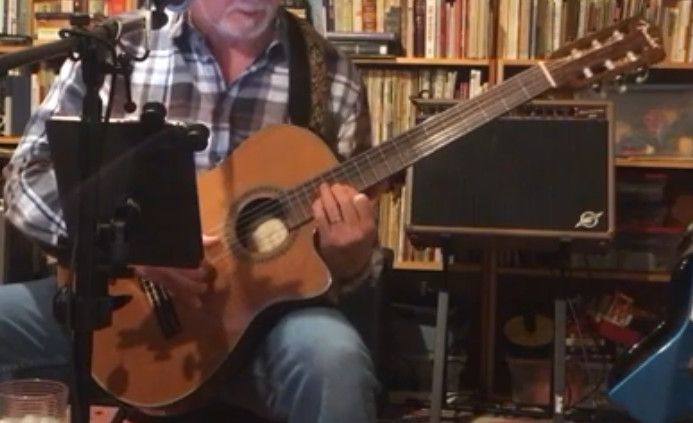
Note. this is my older musical alter ego, Jim Dumas. Jim plays music >~= Elvis. Jaz is <~= Elvis. Note also, I use the harmony box at the end, on “Something happenin' there”.
Here's the song:
Here's a song demonstrating points 2 & 3 above: the Hoagy Carmichael classic “stardust”. I think this is pretty much Willie Nelson's version. You start the recording late. You start & stop the loop to solo over it 2x.
I (or rather Jim Dumas) have been thinking I'll go back & try some modern (> Elvis) songs with the looper. Some Hendrix maybe?